
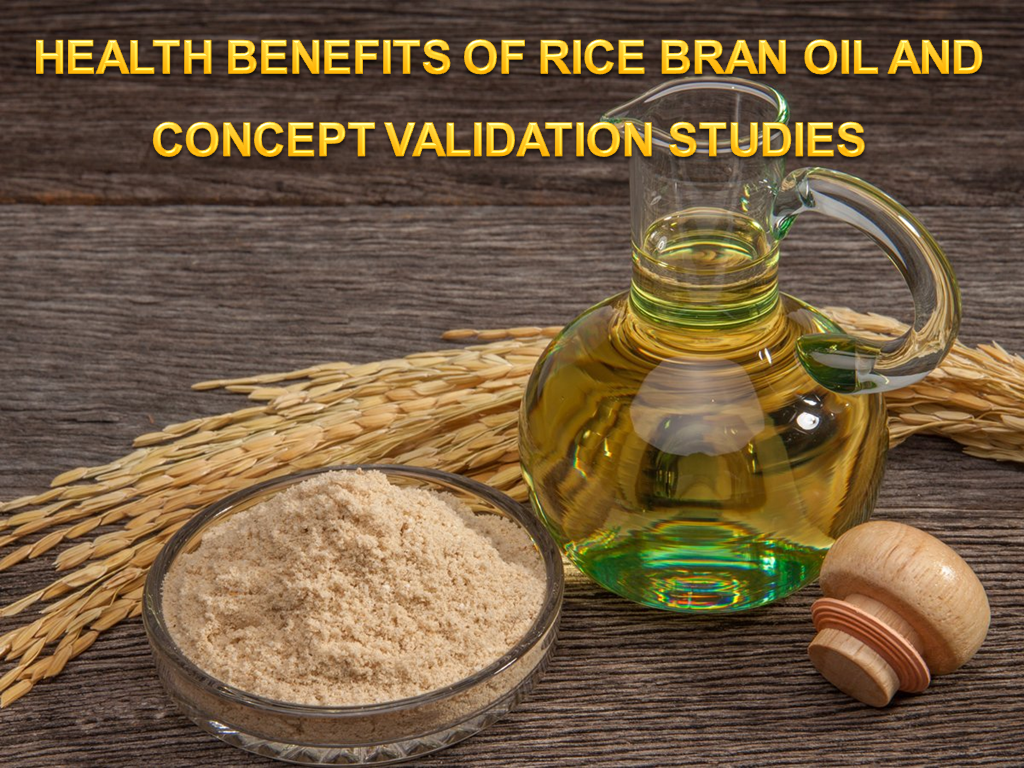
Rice bran being a prominent by-product of rice industries, gained popularity in past few years across globe due to its nutritional content which contains many bioactive components, thus contributing a healthy lifestyle. Due to its gigantic nutritional profile, it is used to prepare edible oil known as ‘Rice bean oil’.
Accounting to the nutritional superiority of Rice bran oil over the other edible oils are its saturated, monounsaturated and polyunsaturated fat profiles. Additionally, it contains bioactive components such as Oryzanol, Tocotrienols, Tocopherols, Phytosterols, etc. which have already been tested through clinical trials and pre-clinical studies for their therapeutic properties.
Itemizing a couple of health benefits of rice bran oil:
- Managing hyperlipidemia: Rice bran oil is capable of efficiently managing hyperlipidemia because it constitutes Oryzanol and Tocopherols as its bioactive components which are effective in lowering blood lipid levels. On the contrary, most of the cooking oils, these days, raise the blood lipid levels, thus, the replacement of those cooking oils with rice bran oil can help manage the disease easily.
Currently available clinical studies have proved the capability of rice bran oil to reduce blood lipid levels in human subjects (Jolfaie NR et al., 2016). This property has also been proved well in managing disturbed lipid levels in diabetics (Salar A et al., 2016). This property can be validated by doing pre-clinical studies and clinical trials on animals and humans respectively.
- Maintaining health of the heart: By lowering the blood lipid levels, it can also help in administering the flow of blood through the heart vessels without any interruption from the fat deposits, thereby, effectively maintaining the health of human heart, resultantly generating the possibility of using rice bran oil as cooking oil in daily life.
The effectiveness and safety of the rice bran oil has been evaluated for leading a healthy heart. The rice bran oil can be used by the human subjects as cooking oil and the heart-related tests can be done, such as measuring Blood pressure, Cholesterol etc. which are good indicators for testing the condition of the heart (Devarajan S et al., 2016). Similarly, clinical studies can also be done for rice bran oil comparing it with any other edible oil.
- Antioxidant property: Known for its exceptional anti-oxidant potential, rice bran oil can fight against oxidative stress inside human body. Oryzanol present in rice bran oil is tested at pre-clinical levels to contain high anti-oxidant potential. Thus, rice bran oil is capable to lower the risk of diseases caused due to oxidative stress such as skin aging, atherosclerosis, cancer, inflammation, etc.
There are many pre-clinical studies and clinical trials available which can help in proving such antioxidant potential of rice bran oil (Salar A et al., 2015). In addition to this, Anti-oxidant activity assay is another approach which can be used to test its effectiveness of rice bran oil as a good anti-oxidant compound for human body.
How do you plan a clinical study on edible oils & what are the critical points?
To conduct clinical trials related to edible oils such as rice bran oil, following critical points should be considered to increase to positive output from the trial:
- Prepare a well-planned protocol, mentioning minor and major details related to each aspect of the complete trial.
- The edible oil previously used by the patients should be completely eliminated while conducting clinical study with the edible oil of study e. the edible oil of the study should be the only oil to be used by the patients at home.
- Try to keep multiple arms in the study from which patients in one arm might consume the edible oil (investigational product) alone and patients in another arm might contain edible oil blended with other oil.
- While consuming edible oil (investigational product), the patients should be instructed with lifestyle changes, too, as the bad eating habits of the patients are prime reason behind diseased state. But this should be separately placed in a separate arm to measure the actual effect of the lifestyle changes on human body.
- Keep an arm with healthy subjects on edible oil of the study.
- The patient data should be accurately and neatly recorded in CRFs with complete data of edible oil consumption.
- If possible, physical activity should also be considered, as a part of lifestyle changes, while planning the clinical trial with edible oils.
- Try to screen and enroll patients from as much age groups as possible.
- Always keep an eye over the patients whether they are compliant with the edible oil provided by the study only and not using any other oil. This can be monitored during follow-ups or by using patient diaries.
- Beside other laboratory investigations, blood pressure (heart profile), body weight and lipid profile should definitely be considered as important criteria for evaluating the outcome from trial.
- Those patients who have diseases related to organ failure should not be enrolled, as their concomitant medications could interfere with the effect of edible oil.
So, without any second thoughts, get your rice bran edible oil clinically evaluated for its therapeutic efficacy, which will help you to develop your rice bran edible oil most efficiently and scientifically establish the claim for its benefits, safety and efficacy.
References
- https://pdfs.semanticscholar.org/3f50/8a234060190215509d0fa011dec7e1041f81.pdf
- https://www.omicsonline.org/health-benefits-of-rice-bran-a-review-2155-9600.1000108.php?aid=1923
- https://www.annmariegianni.com/rice-bran-oil-for-skin-the-deeply-hydrating-anti-aging-ingredient/
- https://www.thieme-connect.com/products/ejournals/html/10.1055/s-0042-105748
- http://www.sciencedirect.com/science/article/pii/S1933287415004535
- http://jnsd.tums.ac.ir/index.php/jnsd/article/view/20
